
Encontros à chuva
Rain encounters
Este projeto centra-se nos anfíbios do Alto Alentejo, num local chamado Castelo Cernado, Portugal.
O foco deste projeto é dar a conhecer estes anfíbios através da fotografia, das suas cores e beleza, desvendando o folclore e a má reputação que têm, e relembrando os usos que alguns tiveram para as pessoas ao longo dos anos. Lembrando que estes animais têm um papel ecológico que nos afeta positivamente, contrariando à sua reputação.
This project focuses on the amphibians of Alto Alentejo, in a place called Castelo Cernado, Portugal.
The focal point of this project is to make these amphibians known through photography, their colors and beauty, unveiling the folklore and bad reputation they have, and remembering the uses that some have had for people over the years.
Remember that these animals have an ecological role that affects us positively, contrary to their reputation.


O tritão-pigmeu marmoreado (Triturus pygmaeus) é uma das espécies mais interessantes que podemos encontrar nas noites de chuva, se conseguir encontrar, porque como o nome sugere, esta espécie não cresce muito, atingindo apenas cerca de 14cm, e tem uma cor magnífica que ajuda a camuflar-se na vegetação e em ambientes aquáticos. Tal como a salamandra de costelas salientes, o tritão-pigmeu também se encontra num estado de conservação quase ameaçado, pelas mesmas razões e devido à perda de habitat.
The pygmy marbled newt (Triturus pygmaeus) is another species that we can find on rainy nights, if you can find it, because as the name suggests, this species does not grow much, only reaching around 14cm, and it has a magnificent color that helps it camouflage in vegetation and aquatic environments. Like the sharp-ribbed salamander, the pygmy marbled newt is also in near-threatened conservation status, both for the same reasons and due to habitat loss.
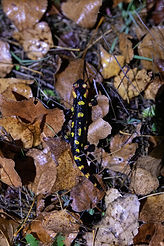


A salamandra de fogo (Salamandra salamandra) é a mais comum destas espécies e tem vários nomes, como salamandra comum ou salamandra de pintas amarelas, mas o mais interessante é a salamandra de fogo, pois a razão deste nome advém do facto de que no passado acreditava-se que estes eram imunes ao fogo. A razão para acreditar nisso é que quando se fazia fogueiras, essas criaturas muitas vezes saíam da lenha em chamas. Mas é claro que não são imunes ao fogo.
Estas salamandras gostam de se refugiar dentro de troncos, que quando se queimam fogem. Como têm muita humidade no corpo, muitas vezes saem ilesos, por isso as pessoas acreditavam nisso. As salamandras encontradas aqui são na verdade uma subespécie da salamandra de fogo, a salamandra gallaica. A diferença é que estes apresentam não só manchas amarelas, mas também vermelhas ou rosadas, sendo até raros os casos em que têm o corpo quase totalmente preenchido por esses tons. As salamandras, por muitas pessoas, são na verdade consideradas criaturas venenosas das quais devem ser mantidas afastadas. É verdade que são inofensivos para as pessoas, mas têm seus meios de defesa, como o veneno que armazenam nas glândulas. É claro que se tentarmos comê-lo seremos afetados pelo veneno ou se as bolsas das glândulas se romperem. Portanto, a melhor forma de lidar com esses animais é não prejudicá-los.
The fire salamander (Salamandra salamandra) is the most common of these species and has several names, such as common salamander or yellow-spotted salamander, but the most interesting is the fire salamander, as the reason for this name comes from the fact that in the past it was believed that these were immune to fire.
The reason for believing this is that when a fire was made, these creatures often came out of the burning wood. But of course they are not immune to fire.
These salamanders like to take refuge inside logs, and when they were set on fire, they fled. As these animals have a lot of moisture in their bodies, they often emerge unharmed, which is why people believed this.
The salamanders found here are actually a subspecies of the fire salamander, the salamander gallaica. The difference is that these have not only yellow spots but also red or pinkish ones, there are even rare cases in which they have the body almost completely filled with these tones.
Salamanders, by many people, are actually considered venomous creatures that should be kept away from. It is true that they are harmless to people, but they have their means of defense such as the poison that they store in their glands.
Of course, if we try to eat it we will be affected by the poison or if the gland pouches rupture.
Therefore, the best way to deal with these animals is not to harm them.


As salamandras de costelas salientes (Pleurodeles waltl) eram bastante comuns há uns tempos atrás, surgindo entre os meses de inverno e primavera com as primeiras chuvas, tanto que costumavam ser capturadas e colocadas dentro de poços para mantê-los livres de outras criaturas menos desejáveis.
Por isso eram conhecidos também como limpa poços.
Sharp-ribbed salamanders (Pleurodeles waltl) were quite common some time ago, appearing between the months of winter and spring with the first rains, so much so that they used to be caught and placed inside wells to keep them clean from other less desirable creatures. For this reason they were known as well salamanders, or well cleaners. Nowadays, the majority of new generations are unaware of this once so common species, its decline in recent years is due to invasive exotic species such as crayfish, among others, therefore, this species has the conservation status of almost threatened.
View Gallery
There may be no better way to communicate what we do than through images. As you browse our site, take a few moments to let your eyes linger here, and see if you can get a feel for our signature touch.


Além de salamandras e tritões, aparecem também os sapos, criaturas mais conhecidas que aparecem com a chuva. São ainda mais evitados que as salamandras, apesar de serem inofensivos. Sua aparência deu asas à imaginação das pessoas e por isso existe muito folclore em torno desses animais. Por exemplo, muitos acreditam que se tocarem num sapo ficam com verrugas e que os sapos estão relacionados com bruxas. Também é muito comum o medo de sapos “xixi” nos olhos das pessoas e cegando-as. Este último tem alguma verdade porque os sapos usam esse método como meio de defesa, mas não o fazem batendo nos olhos das pessoas e mesmo que o fizessem, não causa cegueira nem nada além de um grande incômodo. O que na verdade pode ser perigoso é o veneno que eles armazenam nas glândulas próximas à cabeça, isso pode levar à cegueira e outros problemas, mas os sapos não podem injetar ou expelir esse veneno, ele só serve para defesa quando é atacado e as glândulas quebram para baixo liberando as toxinas.
In addition to salamanders and newts, toads also appear, the best-known creatures that appear with the rain.
These are even more avoided than salamanders, despite being harmless. Their appearance gave wings to people's imagination and that's why there is a lot of folklore surrounding these animals. For example, many believe that if they touch a toad they get warts and that toads are related to witches.
Also very common is the fear of toads "peeing" into people's eyes and blinding people. The latter has some truth because frogs use this method as a mean of defense, but they don't do it by hitting people in the eyes and even if they did, it doesn't cause blindness or anything other than a great inconvenience.
What can actually be dangerous is the poison that they store in the glands near the head, this can lead to blindness and other problems, but toads cannot inject or expel this poison, it is only used for defense when it is attacked and the glands breaking down releasing the toxins.